Wedding Season & Gold Buying Muhurat 2026–2027
Shaadi season, vivah muhurat aur sona khareedne ki guide
Dec 2026–May 2027 vivah muhurat calendar, Kharmas dates, Basant Panchami & Akshaya Tritiya 2027, plus bridal 22K/18K gold budget, HUID and bill checklist.
Published
By Bhavflow Team · Reviewed by the Bhavflow data team, · Methodology & editorial policy · Report an error
Today’s rates
Gold & silver rate today
Today’s rates · 27 Nov
₹1,25,107/10 g
₹12,511/g
₹1,14,681/10 g
₹11,468/g
₹93,830/10 g
₹9,383/g
₹1,55,134/kg
₹1,551/10 g
Note: Indicative rate, excludes 3% GST and making charges. How we calculate
Planning jewellery purchases for a winter or spring wedding? Check today’s gold rate in India and use this 2026–2027 muhurat calendar, buying timeline and bill checklist before visiting a showroom.
⚡ Quick summary
- December 2026 wedding window: 7 auspicious vivah muhurat dates run between 2 and 12 December 2026, followed by the Kharmas pause (~16 December 2026 to 14 January 2027) — an ideal quieter month for custom jewellery orders.
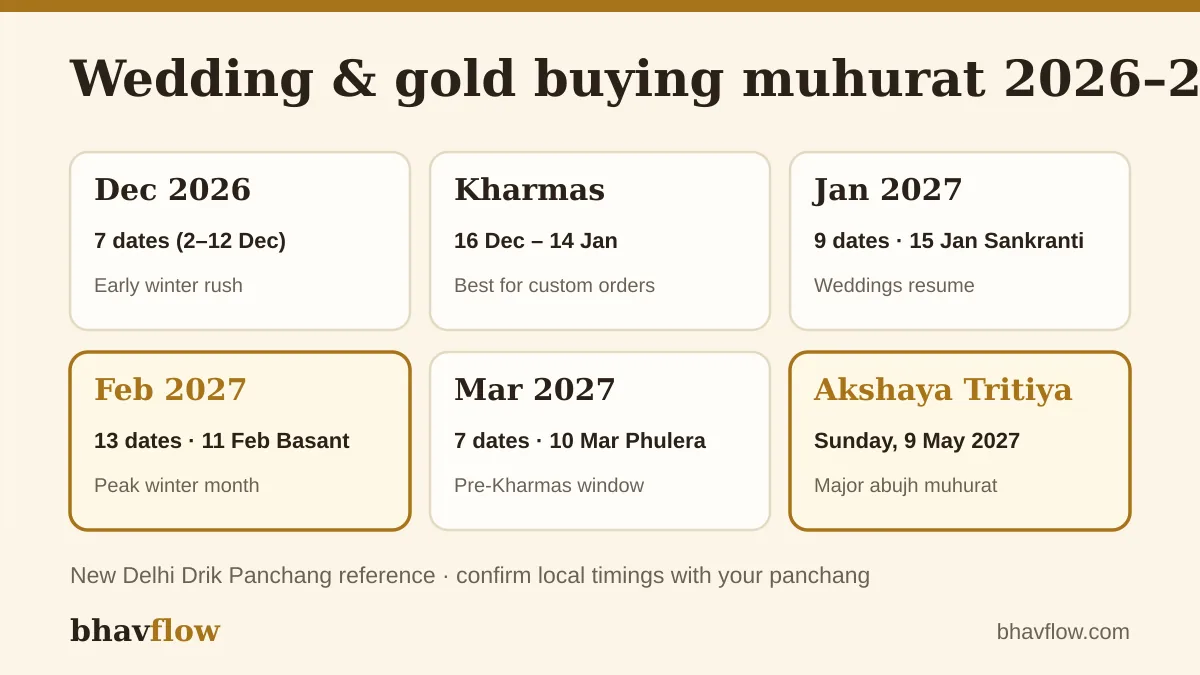
- Winter–spring 2027 peak: Weddings resume on Makar Sankranti (15 January 2027), peak in February 2027 (13 dates including Basant Panchami on 11 February), and include Phulera Dooj (10 March) and Akshaya Tritiya on Sunday, 9 May 2027.
- Smart buying rule: Metal prices follow international bullion, not wedding dates. Save meaningfully by staggering purchases, comparing making charges (typically 8–25%), verifying every piece’s 6-character HUID, and getting an itemised 3% GST bill.
📑 On this page
2026–2027 Muhurat Calendar Buying Timeline Bridal Karat & Weights Exchange, GST & PAN Rules HUID & Bill Checklist FAQWedding & gold buying muhurat calendar (Dec 2026 – May 2027)
The dates below follow North Indian New Delhi Drik Panchang calculations for reference. Exact auspicious windows vary slightly by city sunrise, regional almanac (Tamil, Bengali, Marathi, Gujarati, Kannada or Telugu panchang) and family custom — always confirm specific ceremony timings with your local priest.
| Month / Window | Key Vivah Muhurat & Gold Dates | Showroom & Buying Note |
|---|---|---|
| December 2026 | 2, 3, 4, 5, 6, 11, 12 December (7 dates) | Peak early-winter wedding rush; custom orders need advance booking. |
| Kharmas Pause | ~16 December 2026 – 14 January 2027 (no wedding muhurat) | Quieter showrooms — best window to compare making charges and place custom orders for Jan–Feb weddings. |
| January 2027 | 15 (Makar Sankranti / Pongal), 18, 19, 20, 24, 26, 27, 30, 31 January (9 dates) | Weddings resume after Sankranti; strong demand for bridal sets and coins. |
| February 2027 | 2, 3, 9, 10, 11 (Basant Panchami abujh muhurat), 14, 15, 21, 22, 25, 26, 27, 28 February (13 dates) | Busiest winter wedding month; expect crowded showrooms on weekends and around 11 Feb. |
| March 2027 | 1, 2, 3, 4, 9, 10 (Phulera Dooj abujh muhurat), 14 March (7 dates before Meena Kharmas) | Last spring window before Meena Kharmas (~15 Mar – 14 Apr 2027). |
| Akshaya Tritiya 2027 | Sunday, 9 May 2027 (Tritiya Tithi: 11:42 AM Sat 8 May – 9:03 AM Sun 9 May IST, Delhi) | Major abujh muhurat for weddings and gold coins; pre-booking starts 2–3 weeks early. |
How to time wedding gold purchases without rushing
Indian retail gold prices track international dollar spot prices and USD–INR exchange rates, not local wedding dates. Buying everything in one hurried weekend right before the wedding rarely gives a better price — and leaves little room to compare making charges or check hallmarks calmly.
- 6–8 weeks before the wedding: Finalise your total gram budget across 22K and 18K pieces using our jewellery price calculator. Shortlist designs during quieter periods such as Kharmas or weekday mornings.
- Split into 2–3 tranches: Buying heavy bridal pieces (necklace, bangles) separately from smaller items (chains, rings, coins) spreads price-swing risk over several weeks instead of betting on one day’s rate.
- Confirm rate-lock rules in writing: If you place a custom order or advance booking, ask whether the jeweller locks the booking-day rate, charges the delivery-day rate, or applies the lower of the two — and get that rule printed on the receipt.
Choosing 22K vs 18K and planning wedding weights
Most traditional Indian bridal sets — necklaces, mangalsutras, bangles, jhumkas and temple harams — are crafted in 22K (916) gold because it blends rich colour with strength. For diamond engagement rings, studded bracelets and daily-wear cocktail jewellery, 18K (750) gold holds stones more securely. For shagun coins and bars, pick 24K (999) fine gold.
Compare exact weight benchmarks before negotiating: check 10 gram gold rate (North & West India standard), 1 tola gold rate (11.6638 g), 8 gram sovereign (pavan) rate for South Indian bridal budgets, and 100 gram gold rate for larger family allocations.
Making charges, 3% GST, old-gold exchange and PAN rules
- Making charges (8–25%): Plain machine-made chains sit near the lower end of the 8–25% range; hand-crafted antique, temple, filigree and bridal sets sit higher. Always compare two or three shops on the total bill, not just the per-gram metal rate.
- 3% GST nationwide: Under CBIC GST rules, gold and silver jewellery carry 3% GST on the combined metal value plus making charges across every Indian state.
- Old-gold exchange: Many families melt heirloom jewellery for weddings. Insist on non-destructive karatmeter testing in front of you, check net pure weight after removing stones/solder, and confirm the exact deduction percentage before melting.
- PAN and cash-limit rules: Under Income Tax Rule 114B, quoting PAN is mandatory for jewellery or bullion purchases exceeding two lakh rupees per transaction. Under Section 269ST, cash receipts of two lakh rupees or more in a single day or transaction are prohibited — pay larger wedding bills via UPI, NEFT/RTGS or card.
Hallmark, HUID and bridal bill checklist
Before paying at the counter, verify every hallmarked piece under BIS hallmarking rules: look for the BIS logo, purity mark (such as 22K916 or 18K750) and the 6-character alphanumeric HUID, then verify that HUID inside the BIS CARE mobile app.
- Net gold weight vs gross weight: For studded, kundan, polki, jadau or black-bead mangalsutra pieces, make sure stone/bead weight is deducted and only net gold weight is multiplied by the gold rate.
- Itemised GST bill: Keep a proper tax invoice listing each item’s HUID, purity, net gold weight, stone weight, rate per gram, making charge, 3% GST and written buy-back / exchange terms.
FAQ
1. Can I buy wedding gold during Kharmas (mid-December to mid-January)?
Traditional Hindu weddings pause during Kharmas (~16 Dec 2026 – 14 Jan 2027), and some families prefer taking delivery on an auspicious day after Makar Sankranti. However, showrooms stay open and far less crowded during Kharmas — making it a practical time to shortlist designs, compare making charges or place custom orders for later pickup.
2. Do gold rates automatically rise on wedding muhurat days?
No. Domestic gold rates are driven primarily by international spot gold prices, USD–INR exchange rates and import duties. What rises during peak wedding weeks is showroom crowds, waiting times for custom designs and occasionally local dealer premiums.
3. Are kundan, polki and jadau bridal sets hallmarked?
Under BIS rules, traditional kundan, polki and jadau jewellery are exempt from mandatory hallmarking. Plain 22K and 18K wedding jewellery (above 2 grams) must carry a 6-character HUID hallmark. For exempt pieces, insist on written net gold weight, purity and exchange terms on the GST bill.
4. When is Akshaya Tritiya in 2027?
In India, Akshaya Tritiya (Akha Teej) falls on Sunday, 9 May 2027, with Vaishakha Shukla Tritiya Tithi running from 11:42 AM on Saturday, 8 May to 9:03 AM on Sunday, 9 May 2027 (New Delhi Drik Panchang reference).
Sources
- Drik Panchang: Akshaya Tritiya 2027 Date & Timings (New Delhi)
- BIS (Bureau of Indian Standards): Hallmarking FAQs
- CBIC: GST Goods & Services Rates (3% GST on Gold & Jewellery)
Links checked on 23 Nov 2026.